


Two names that consistently come up in that conversation are Koala AI and Jasper. Both are capable, are well-funded and have audiences of writers, marketers and content teams who swear by them. But they were built with different priorities and those differences become very obvious when you ask either tool to produce something longer than a product description or a social media caption.
Long-form content - blog posts, pillar pages, guides - is where the difference between a AI writing tool and a great one can become impossible to ignore. Structure, coherence, depth and the ability to actually stay on topic across thousands of words matter enormously. Choosing the wrong tool doesn't just waste money; it costs time you don't have.
I'll put Koala AI and Jasper head-to-head specifically on long-form writing performance. You'll get a clear picture of how each tool handles the demands of making big content - so you can choose the one that actually fits the work you're doing.
Short Summary
Koala AI generally performs better for long-form content, particularly for SEO-focused blog posts, offering real-time web data, automatic internal linking, and Amazon affiliate integration at a lower price point. Jasper excels in marketing copy, brand voice consistency, and team collaboration features, but requires more manual input for long-form content and costs significantly more. For straightforward, automated long-form blog writing, Koala AI wins. For versatile marketing content with strong brand control, Jasper is the better choice.
What Each Tool Is Actually Built to Do
Koala AI was built with one goal in mind: to help publish SEO-optimized content at scale - it serves over 19,000 content creators and has generated more than 10 million internal links across the content it produces. That last number is worth pausing on, because internal linking is a fairly tedious part of SEO that most writers do manually. Koala automating it at that volume tells you quite a bit about where its goals sit.
The tool is built around the idea that you should be able to go from a keyword to a publish-ready post with as little friction as possible - it pulls in real-time data from search results to inform its output, so the content it generates is grounded in what is actually ranking. It is not a general-purpose writing tool with SEO features bolted on - SEO is the foundation.
Jasper takes a different strategy - it was designed to be a flexible writing assistant for marketing teams, which means it covers a much wider number of content types. Blog posts, ad copy, email campaigns, social media content - Jasper is built to manage it from one place.
That breadth is deliberate. Jasper's core audience is marketing teams who need to produce different content without switching between a dozen different tools - it comes with a library of templates and supports brand voice settings so everything a team produces sounds consistent. The trade-off is that it was not built specifically around SEO workflows the way Koala was.

Neither tool is trying to be the other, and that's helpful to know before diving into feature comparisons. Solo bloggers or SEO agencies making post-driven content at volume will find Koala's whole architecture pointing in their direction. Marketing teams that need one tool to cover blog posts on Monday and ad copy on Wednesday will find Jasper was built with them in mind - though it's worth knowing there are Jasper alternatives that handle direct WordPress publishing if that matters to your workflow.
The distinction matters because both tools do write long-form content. But the way they approach it, what they prioritize, and what they assume you need from the output are shaped by these different starting points. That is what makes a direct comparison interesting instead of easy.
Long-Form Writing Features Side by Side
Both tools have a document editor and auto-outline generation, so on the surface they look pretty similar. The way each one works with a full blog post or pillar page from start to finish is where the differences start to show up.
Jasper's editor gives you flexibility. You can build a document piece by piece, you can use templates to frame your structure and adjust the output as you go - it works if you want to stay in the driver's seat and shape the content yourself. The trade-off is that it asks more of you - more prompts, more decisions, more to get a finished draft.
Koala AI takes a more automated path. You put in a topic or keyword and it generates a full structured post with headings, sections and body content already in place; it's helpful for writers who need volume or who want a strong first draft without spending time on scaffolding. It's also worth knowing that Koala AI has a built-in internal linking system with over 10 million links generated - it's an actual edge for SEO-focused content.
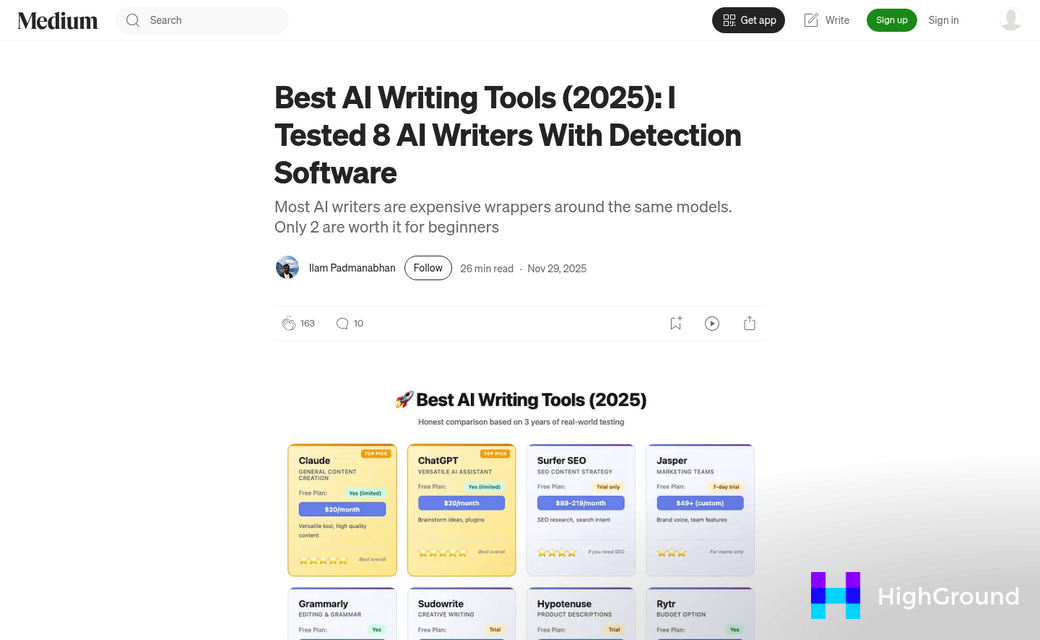
Here's a quick look at how the two tools compare on the features that matter most for long-form writing.
| Feature | Koala AI | Jasper |
|---|---|---|
| Long-form editor | Yes | Yes |
| Auto-outline generation | Yes | Yes |
| Internal linking | Yes (10M+ links generated) | Limited |
| SEO optimization built-in | Strong | Moderate |
The table makes Koala AI look like the obvious pick for SEO content and for those use cases it probably is. But think about what you actually need day to day.
If you write guides that need a steady brand voice and a human touch throughout, Jasper's manual approach can produce something more refined. Auto-outline generation only saves you time if the outlines it creates are good enough to use without heavy edits.
The same thing goes with internal linking. Automated links are a time-saver. But you still want to check that the links are relevant and placed well. No tool removes the need for a human to review the final output.
Output Quality - Depth, Accuracy, and Readability
Quality in long-form content is harder to pin down than it sounds. Grammar and word count matter. But so does if a reader gets to the end of a piece and they learned something.
Koala tends to produce content that reads cleanly and stays on topic - it pulls from real-time web data, so it helps ground claims in something current instead of generic. It works with nuance reasonably well for a writing tool. But it doesn't go deeper than surface level without a push from the user.
Jasper writes with more variation in sentence rhythm, which makes longer pieces feel less repetitive to read. The output can seem more polished in tone. But it doesn't always back up its points with detail. That difference between confident writing and depth is worth watching for. A well-structured piece can still not say much.
One data point worth mentioning: Jasper-written email campaigns have seen 12% more opens and 8% more clicks compared to control content. But email copy and long-form articles are different animals. Short persuasive writing rewards snappy, confident language - which is where Jasper tends to be at its best. That same strength might not translate to a 2,000-word guide.
For long-form specifically, the editing load matters quite a bit. Koala outputs tend to need less structural editing because the format comes out cleaner from the start. Jasper may need more passes to add substance underneath the polish. Neither tool gives you something publishable without at least one edit. But the type of editing each needs is different.
Accuracy is the other part of this. Koala's web-connected strategy cuts back on the chance of outdated or invented facts. Jasper can still produce plausible-sounding statements that don't hold up under fact-checking. For any content where accuracy matters - health, finance, legal topics - it's a gap to account for in your editorial process. How you handle that gap often shapes how much AI content actually costs per post once editing time is included.
Both tools write well enough to be helpful. The difference shows up in what work you want done after the draft lands in your editor. If you're weighing other options, comparing Jasper against Rytr on ROI is worth a look before committing to either.
Pricing and Word Count Value Compared
The difference between these two tools can become very obvious when you look at the price tags. Koala AI starts at $9/month for 15,000 words. But Jasper's entry plan starts at $49/month with unlimited words; it's a significant difference in cost. But the value you get depends quite a bit on how you work.
| Plan | Koala AI | Jasper |
|---|---|---|
| Entry-level price | $9/month (15,000 words) | $49/month (unlimited words) |
| Mid-tier / Team plan | $49/month (100,000 words) | $99/month (3 seats) |
| Free trial | 5,000 free words | 7-day free trial |
For a solo blogger who publishes two or three articles a week, Koala AI's $9 plan works pretty well. Fifteen thousand words covers a basic output without stretching a tight budget. If you need more room to grow, the $49/month plan bumps you as high as 100,000 words, which is a decent amount for a single content creator or a small freelance operation.
Jasper's pricing structure is built more for teams and agencies. The $49/month entry plan gives you unlimited words, which sounds appealing. But it's a single-user experience at that price point. To get collaborative features and multiple seats, you're looking at $99/month for three users; it's a reasonable split across a small team. But it's not designed with the budget-conscious solo writer in mind.
Koala AI gives you 5,000 free words to use before you pay anything, which lets you test it on a post. Jasper's 7-day trial gives you time-based access, so how much you get to test depends very much on how much time you put in during that window. If you're evaluating other options at similar price points, there are Copy.ai alternatives worth considering for small business owners too.
These tools are priced for different audiences. Koala AI scales affordably from hobbyist to high-volume solo creator. Jasper makes more sense for a team that needs shared workflows, brand voice controls, and collaborative editing. The word count alone doesn't tell the full story - the structure around it matters just as much. If you're an agency comparing tools at a higher tier, it's also worth looking at how agencies are moving toward AI-first content workflows more broadly.
Where Each Tool Stumbles With Long-Form Content
Neither tool is perfect, and it's worth being honest about where each one falls short before you put either to work on something that matters.
Koala AI tends to struggle when a topic needs genuine depth - it pulls from patterns in training data, so if you ask it to write about something technical or nuanced, it can produce text that stays at surface level. The arguments don't build on each other the way a knowledgeable writer's would.
Repetition is another weakness. Across a long post, Koala can recycle the same phrases and sentence structures in ways that feel noticeable - it doesn't always hurt readability. But it does make the content feel machine-made in a way that's hard to fix with light edits.
Jasper has a different problem. Its templates and guided workflows push content into familiar shapes, which can make even original topics feel generic. The writing tends to be polished and clean. But it can also say very little beneath that polish. Teams sometimes produce content that reads confidently but makes no argument and gives no information a reader couldn't find anywhere else.

That's a danger for content teams that use Jasper for authority-driven pieces. Blog posts about finance, health, or technical subjects need more than confident phrasing. Jasper can make thin content feel finished, which makes it easy to publish something that won't perform well or build reader trust. If you're comparing your options, see how Claude, ChatGPT, and Gemini handle blog writing differently.
Both tools also share a tendency to hedge. Phrases like "it's important to note" or "there are many factors to consider" show up frequently and add length without adding value. In long-form content, this filler dilutes the quality and can frustrate readers who came for direct answers.
Koala AI needs a writer who can add depth and expert perspective after the draft is done. Jasper needs a person who can push past the polished surface and make sure that the content actually says something worth reading. The editing burden is distributed differently between the two - and if you want a more automated path, auto-writing blog posts with AI in WordPress can help teams keep output consistent without relying on a single tool.
So, Which One Should You Actually Use?
No tool can replace your editorial judgment. The best AI-generated draft is still just a starting point. The angle that makes a reader stop scrolling, the example that lands, the sentence that earns a share - it still comes from you. Use these tools to remove the grunt work - not to outsource your thinking.
FAQs
What is Koala AI best suited for?
Koala AI is best suited for SEO-focused content creators who need to publish optimized blog posts at scale, with built-in internal linking and real-time search data integration.
How does Jasper differ from Koala AI?
Jasper is designed for marketing teams needing versatile content across formats like ads, emails, and blogs, while Koala AI focuses specifically on SEO-driven long-form content production.
Which tool is more affordable for solo bloggers?
Koala AI is more affordable, starting at just $9/month for 15,000 words, making it a practical choice for solo bloggers on a tight budget.
What are the main weaknesses of each tool?
Koala AI can lack depth and repeat phrases in long posts, while Jasper tends to produce polished but sometimes substance-thin content that sounds confident without saying much.
Do either tools produce publish-ready long-form content?
Neither tool produces fully publish-ready content without editing. Koala AI typically needs depth added, while Jasper often requires substantive revisions beneath its polished surface.