
AI-Powered Reporting & Dashboards
See what matters before you have to ask.
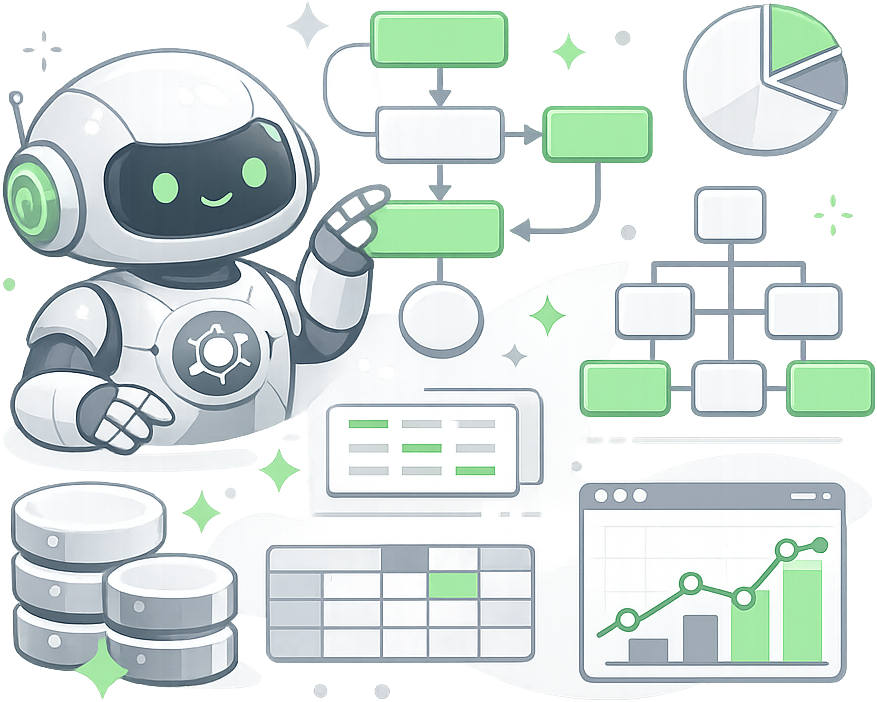
We build live dashboards and automated reports that pull from your tools, analyze trends, and surface the numbers that actually drive decisions. No more digging through spreadsheets on Monday morning - the insights come to you.
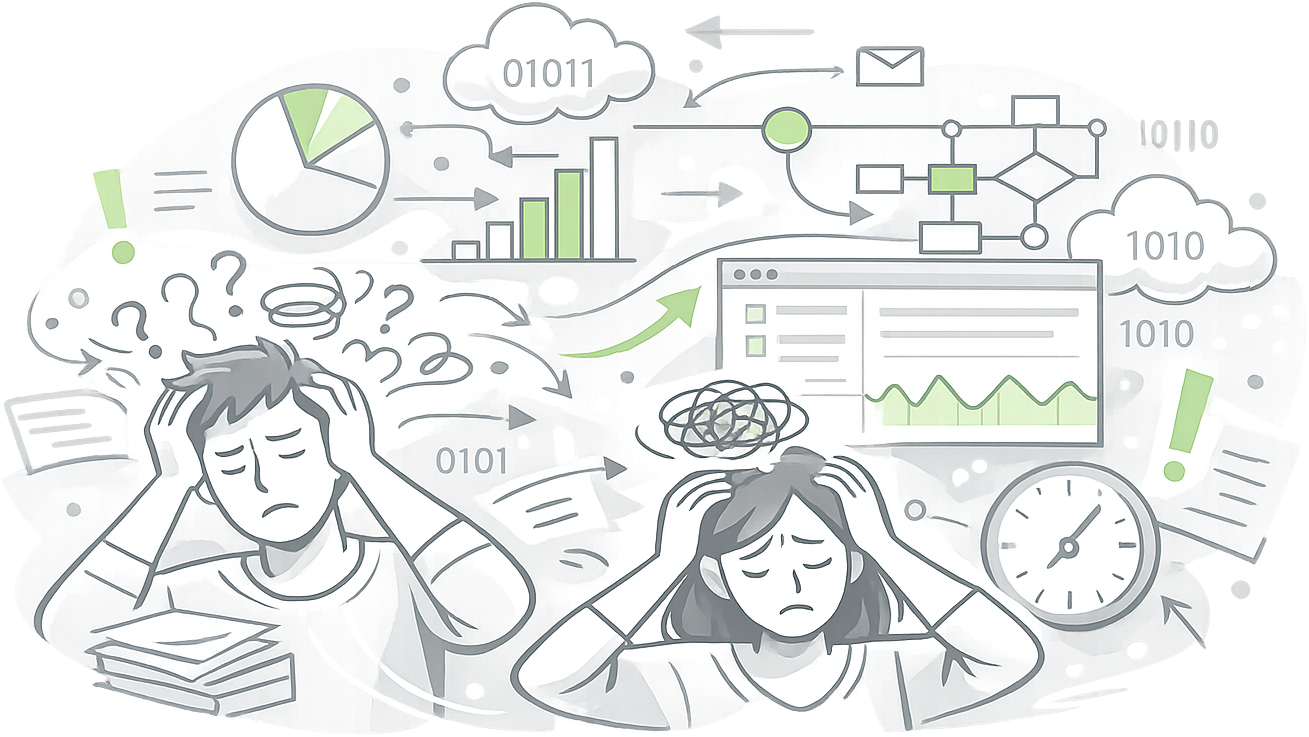
You have more data than ever. You understand less than ever.
Your CRM has pipeline data. Your project tool has utilization numbers. Your ad platform has campaign performance. Your accounting software has revenue and margins. Your help desk has customer satisfaction scores. Your analytics tool has traffic and conversion data.
All of it is useful. None of it is in the same place.
So every week, someone on your team - maybe it's you - spends hours pulling numbers from different tools, pasting them into a spreadsheet, formatting a report, and trying to make sense of it before the Monday meeting. The numbers are already stale by the time anyone reads them. Half the slides prompt questions nobody can answer without going back and digging into another tool. The other half tell people things they already knew.
This isn't a data problem. You have the data. It's a delivery problem. The right numbers aren't reaching the right people at the right time in a format that makes the next decision obvious.
And now there's a layer that most reporting tools completely miss: interpretation. A dashboard can show you that revenue dropped 12% last month. It can't tell you why, what changed, and what to do about it. A human can - but only if they have time to stare at the numbers long enough to spot the pattern. Most people don't have that time.
AI closes both gaps. It pulls the data together. And it reads it for you.
What we build
Reporting that thinks, not just displays.

Executive Dashboards
A single screen that tells leadership what they need to know right now. Revenue, pipeline, burn rate, project health, key metrics - pulled live from your actual tools, not from a spreadsheet someone updated last Thursday. Designed to answer the questions that come up in every leadership meeting without anyone having to prepare a deck first.
Automated Weekly & Monthly Reports
Reports that build and deliver themselves. Every Friday afternoon, a written summary hits your inbox or Slack channel - here's what happened this week, here's what's trending, here's what needs attention. Not a CSV dump. Not a wall of charts. A concise, AI-generated narrative that highlights what matters and skips what doesn't.
Sales & Pipeline Dashboards
Real-time visibility into your pipeline - deals by stage, conversion rates, rep activity, revenue forecasts, deal velocity. Connected to your actual CRM so the numbers are always current. AI layers on risk scoring, pattern recognition, and plain-English summaries that save your sales manager from living inside the CRM.
Marketing Performance Dashboards
Campaign spend, lead volume, cost per acquisition, channel attribution, content performance, email metrics - all in one place instead of spread across six platforms. AI highlights what's working, what's underperforming, and where your budget would have the most impact next month.
Operational & Project Dashboards
Team utilization, project status, budget tracking, milestone completion, resource allocation - for agencies, service businesses, and any team running multiple concurrent projects. AI flags projects that are trending over budget or behind schedule before they become problems.
Custom KPI Tracking & Alerts
Not every important metric fits a standard dashboard. We build custom tracking for the numbers that matter most to your specific business - customer health scores, inventory velocity, support response times, whatever drives your decisions. AI monitors continuously and alerts the right person when something crosses a threshold, with context about what changed and why.
The AI layer
Dashboards show you numbers. We make them talk.

Automated narrative summaries.
Every dashboard and report includes AI-generated plain-English analysis. Not just "revenue was $247K" but "revenue was $247K, down 8% from last month, driven primarily by a drop in enterprise deal closures. Mid-market pipeline remains strong and is trending 15% above last quarter." The kind of context that used to require an analyst staring at a screen for an hour.
Anomaly detection.
AI monitors your metrics continuously and flags when something deviates from the pattern - a sudden spike in support tickets, an unusual drop in conversion rate, a campaign that's outperforming everything else. You get alerted with context, not just a number. Most problems and opportunities are visible in the data days before anyone notices them manually.
Trend analysis and forecasting.
Where are things headed? AI reads historical patterns and projects forward - pipeline likely to close this quarter, revenue trajectory based on current trends, capacity crunch coming in six weeks based on project load. Not crystal-ball predictions. Data-informed projections that help you plan instead of react.
Natural language queries.
Ask your dashboard a question and get an answer. "Which campaign drove the most qualified leads last month?" "What's our average deal size for enterprise clients this quarter?" No filters, no pivot tables, no exporting to Excel. Just ask.
How it works
From scattered data to clear decisions in 2–4 weeks.
Data & Reporting Audit
We map where your data lives, how it currently gets reported, and what's falling through the cracks. We talk to the people who consume the reports and the people who build them. What questions does leadership actually ask? What takes too long to answer? What decisions are being made on gut feel because the data isn't accessible?
Architecture & Data Connections
We connect your tools - CRM, project management, accounting, marketing platforms, analytics, help desk, whatever feeds into your decisions. We design the data architecture so metrics are consistent, definitions are agreed on, and everything resolves to a single source of truth. No more "my spreadsheet says something different than yours."
Build & Configure
We build the dashboards, configure the automated reports, set up the AI analysis layer, and define the alert thresholds. You'll see a working version early and we'll iterate based on feedback. Does this view answer the right question? Is this the right frequency? Are these the metrics that actually drive action?
Launch & Evolve
Dashboards go live, reports start delivering, alerts start firing. We monitor to make sure data flows are healthy and the AI analysis is accurate. As your business evolves - new tools, new metrics, new questions - we update the system. The dashboard you use in month six has features and insights you didn't know you needed at launch.
Common data sources
If the data exists, we can pull it in.
We connect to the tools your business actually runs on:

CRM & Sales
HubSpot, Salesforce, Pipedrive, Close, GoHighLevel
Project Management
Asana, Monday, ClickUp, Notion, Linear, Harvest
Accounting & Finance
QuickBooks, Xero, Stripe, FreshBooks
Marketing
Google Ads, Meta Ads, Mailchimp, ConvertKit, ActiveCampaign, Google Analytics, Search Console
Support
Zendesk, Intercom, Freshdesk, Help Scout
Communication
Slack (channel analytics), email platforms
Custom Sources
Databases, APIs, spreadsheets, CSV exports - if there's data in it, we can usually connect it
Everything feeds into a unified layer so your dashboards reflect reality, not a partial view from whichever tool someone happened to check last.
Who this is for
This is a good fit if...
- Someone on your team spends hours every week manually building reports from multiple tools
- Leadership asks questions in meetings that nobody can answer without going back to dig through data
- You're making decisions based on gut feel because the numbers aren't accessible fast enough
- Your reporting is inconsistent - different people pull different numbers and nobody agrees on what's accurate
- You have dashboards that nobody looks at because they're too cluttered, too stale, or too hard to interpret
- You're growing and the manual reporting process that worked at ten people is breaking at fifty
- You want to know when something's off before it becomes a crisis, not after
This probably isn't the right service if you need a full business intelligence platform with data warehousing, complex ETL pipelines, and a team of analysts to operate it. We're built for businesses that need clear, actionable reporting from the tools they already use - not enterprise data infrastructure. If your needs are truly at that scale, we'll tell you and recommend the right kind of partner.
What clients typically see
The numbers after the first 90 days.
5–10 hrs/week
recovered from manual report building. That's someone's entire Monday freed up to do work that actually moves the business forward.
Faster decisions
When the data is live, accessible, and interpreted - the time between "something changed" and "here's what we're doing about it" compresses dramatically.
Earlier warnings
Anomaly detection and threshold alerts mean you catch issues days or weeks before they'd show up in a monthly review. Flagged in real time instead of discovered in hindsight.
One truth
When everyone looks at the same dashboard, fed by the same data sources, with the same definitions - the reporting arguments stop. Meetings shift from debating data to deciding what to do.
These are representative outcomes based on typical engagements. Actual impact depends on current reporting maturity, number of data sources, and team adoption.
FAQ
Common questions about AI-powered reporting & dashboards.
How is this different from the reporting built into our existing tools?
Native reporting shows you what happened inside that one tool. Our dashboards pull from all your tools and show you the complete picture. More importantly, native reporting just displays numbers - our AI layer interprets them, spots patterns, and tells you what's worth paying attention to in plain language. It's the difference between a speedometer and a co-pilot.
Do we need a data warehouse or any special infrastructure?
For most businesses, no. We connect directly to your existing tools via APIs and build a lightweight data layer that handles aggregation and consistency. If your data volume or complexity eventually warrants a warehouse, we'll help you make that transition - but most companies in our target range don't need it on day one.
How real-time is "real-time"?
It depends on the data source. Most CRM, project, and marketing data refreshes every 15–60 minutes. Financial data typically syncs daily. Alerts can fire within minutes of a threshold being crossed. We'll set expectations for each data source during setup - no false promises about instant refresh if the source API updates hourly.
Can different people see different dashboards?
Absolutely. We build role-based views - leadership sees the executive overview, sales sees the pipeline, marketing sees campaign performance, operations sees project health. Everyone gets the data relevant to their decisions without being overwhelmed by everything else.
What happens if one of our tools changes or we switch platforms?
We reconnect the data source. The dashboard architecture is designed to be tool-agnostic - it cares about the data, not which specific platform it comes from. Switching your CRM from Pipedrive to HubSpot doesn't mean rebuilding your dashboards. It means updating one connection.
Can I ask the dashboard questions in plain language?
Yes - that's the natural language query feature. You can type a question like "what was our close rate for enterprise deals last quarter" and get a direct answer pulled from your data. It's not a search bar. It's a conversational interface that understands your metrics and your business context.
How much does this cost?
It depends on the number of data sources, the complexity of the dashboards, and whether you need automated reports and AI analysis or just live visualizations. A focused executive dashboard pulling from three tools is a different investment than a multi-department reporting system with alerts and natural language queries. We'll scope it during discovery.
The numbers are there. They should be working for you by now.
Book a free 30-minute discovery call. We'll map where your data lives, identify what's costing you the most time to report on, and show you what an AI-powered reporting system would actually look like for your business. Clear answers, no jargon, no dashboards you'll never look at.
Or reach out directly at hello@highground.ai