
Internal Knowledge Systems
Stop losing what your company knows.
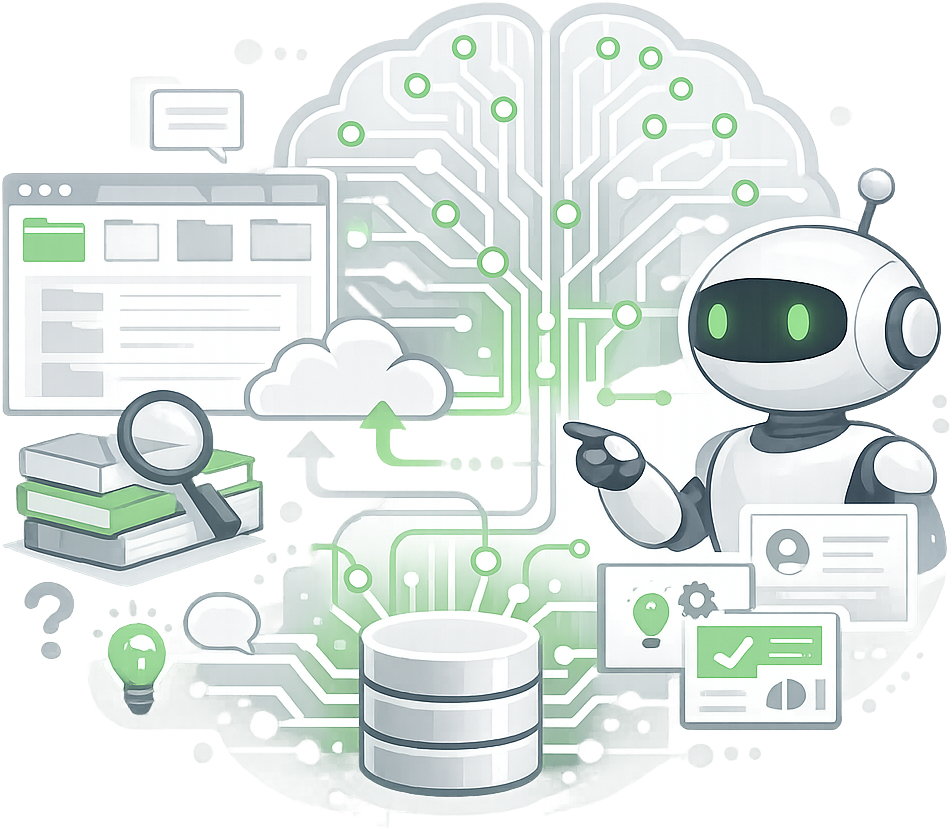
We turn your scattered docs, SOPs, Slack threads, and tribal knowledge into a searchable AI-powered knowledge base. New hires ramp faster. Veterans find answers instantly. Nothing falls through the cracks.
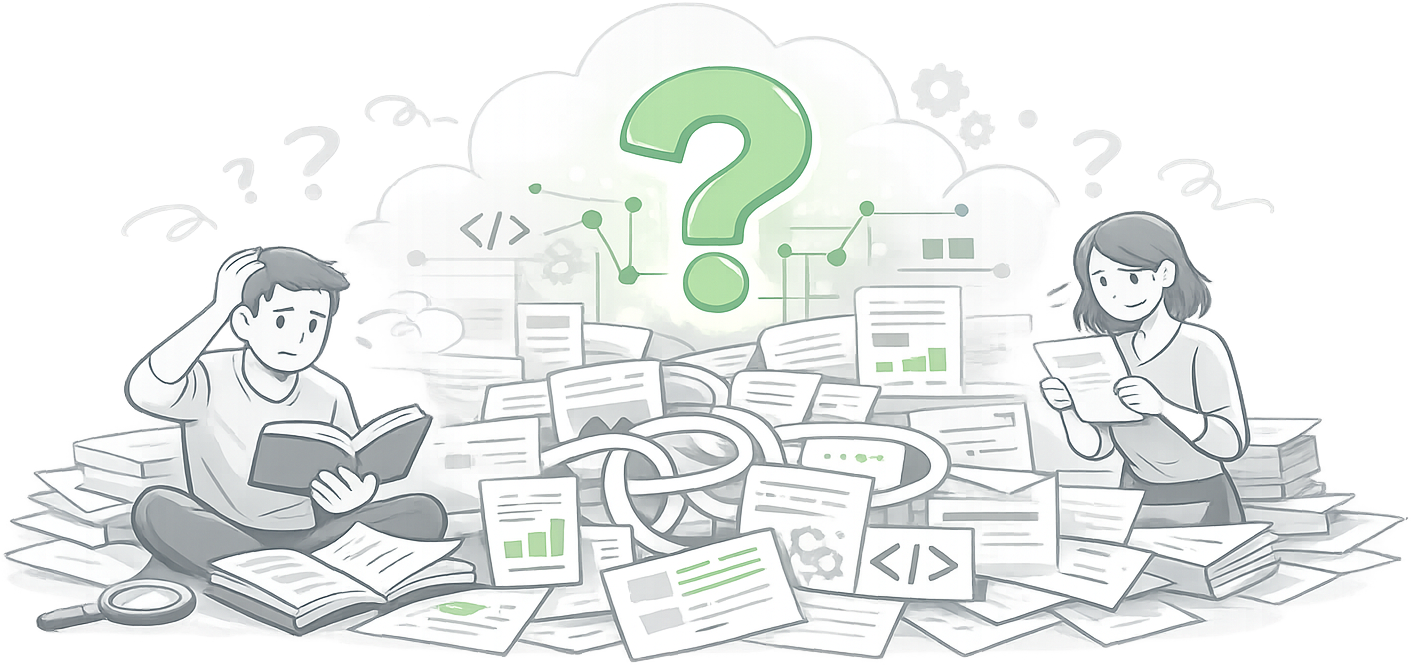
The answer exists somewhere. Nobody can find it.
Your company knows a lot. Years of processes, decisions, client history, product details, lessons learned, policies, workarounds, and hard-won expertise. The problem is where all of that knowledge actually lives.
Some of it's in Google Drive - scattered across 300 folders nobody maintains. Some of it's in Notion, but only half the team uses Notion. Some of it's in Slack threads that disappeared into the scroll three months ago. Some of it's in someone's head - and when that person is busy, on vacation, or gone, the knowledge goes with them.
So what happens? People interrupt each other. The same question gets asked and answered twelve times. New hires spend their first month just figuring out who to ask about what. Two people give conflicting answers because they're referencing different versions of the same doc. Leadership assumes everyone knows the process, but the process was never actually written down.
None of this is a technology problem. You have the tools. You have the documents. What you don't have is a system that makes all of it searchable, current, and instantly accessible - in plain language, without knowing which folder to look in or which person to bother.
That's what we build.
What we build
A knowledge base that actually answers the question.

Company-Wide Knowledge Assistant
An AI-powered search and Q&A tool that sits on top of everything your company knows - SOPs, policies, product docs, process guides, meeting notes, internal wikis. Employees ask a question in plain language and get an accurate, sourced answer pulled from your actual documents. No more digging. No more guessing. No more "I think it's in the shared drive somewhere."
Team-Specific Knowledge Bases
Not every team needs access to everything. We build scoped knowledge systems for individual departments - an HR assistant that answers benefits and policy questions, a sales enablement tool that surfaces product specs and competitive intel, an engineering wiki that's actually searchable. Each one trained on the documents that matter to that team.
Client & Project Knowledge Systems
For service businesses and agencies, institutional knowledge about clients is gold - past decisions, preferences, project history, communication style, key contacts. We build systems that capture and surface this context so every team member working on an account has the full picture, not just whoever's been there the longest.
Onboarding Knowledge Systems
Your best people didn't get good overnight. They spent months learning the unwritten rules, the internal tools, the tribal knowledge that never made it into a doc. We build onboarding-specific knowledge systems that give new hires access to that institutional wisdom from day one. They ask questions, they get answers, they ramp up in weeks instead of months.
Living Documentation Systems
Most documentation dies the day it's written because nobody updates it. We build systems that flag stale content, surface gaps based on what employees are actually asking, and make it easy to keep the knowledge base current without making documentation feel like a second job.
Not another wiki
You've tried wikis. This isn't that.

People ask questions. They don't browse folders.
A wiki only works if someone knows where to look. An AI knowledge system works the way people actually think - they type a question and get an answer. "What's our refund policy for enterprise clients?" returns a direct, sourced answer, not a link to a 40-page PDF.
It pulls from everywhere, not just one platform.
Your knowledge doesn't live in one place. Neither should your knowledge base. We ingest documents from Google Drive, Notion, Confluence, SharePoint, Slack, email archives, PDFs, spreadsheets - wherever your information actually lives. The employee doesn't need to know which tool holds the answer.
It tells you what it doesn't know.
Bad AI makes things up. A good knowledge system tells you when it can't find an answer - and that gap becomes visible. Now you know exactly where your documentation is lacking. Every unanswered question is a signal showing you what needs to be written, updated, or clarified.
It gets better the more people use it.
Every question asked is data. We track what people search for, which answers satisfy them, and where they hit dead ends. Over time, the system gets tuned to the questions your team actually asks - not the ones someone assumed they'd ask when they wrote the wiki three years ago.
Nobody has to maintain it like a full-time job.
Traditional wikis collapse because someone has to manually organize, update, and curate them. Our systems are designed to minimize that burden. Documents are ingested automatically from your existing tools. Stale content gets flagged. New information gets absorbed without someone having to restructure the whole taxonomy.
What we ingest
If it's got text, we can work with it.
Most companies are surprised by how much institutional knowledge they already have - it's just not organized or accessible. We pull from wherever your information lives:

Documents
Google Docs, Word files, PDFs, markdown files, spreadsheets
Wikis & Knowledge Bases
Notion, Confluence, SharePoint, GitBook, Slite
Communication
Slack threads, Teams messages, email archives, recorded meeting transcripts
Project Tools
Asana, Monday, ClickUp, Linear - comments, project briefs, task descriptions
Help Desks
Zendesk articles, Intercom help center, Freshdesk, internal FAQ documents
Code & Technical
README files, internal documentation, API docs, runbooks
Unstructured
Recorded Loom videos (transcribed), voice memos, handwritten notes (scanned and OCR'd)
We handle the ingestion, cleaning, chunking, and embedding. You don't need to organize anything before we start - working with messy, scattered information is literally the point.
How it works
From scattered docs to searchable intelligence in 2–4 weeks.
Knowledge Audit
We map where your company's knowledge currently lives - every tool, every repository, every person who's become an unofficial encyclopedia. We identify what's documented, what's outdated, what only exists in someone's head, and what the most common questions are. This gives us the blueprint for what the system needs to cover.
Ingestion & Architecture
We pull in your documents, process them, and build the retrieval architecture. This means chunking content intelligently, generating embeddings, building the vector database, and configuring the AI to answer questions accurately from your specific data. We tune for your terminology, your acronyms, your internal language - not generic corporate speak.
Testing & Tuning
Before launch, we test with real questions from your team. Does it find the right answer? Does it cite the right source? Does it handle ambiguity gracefully? Does it know when to say "I don't know"? We iterate until the system is genuinely useful, not just technically functional.
Deploy & Evolve
We deploy wherever your team works - Slack, Teams, a web interface, embedded in your intranet, or all of the above. New documents get ingested automatically as they're created. We monitor usage, track unanswered questions, flag stale content, and continuously improve accuracy. The system your team uses in month six is significantly better than the one you launched with.
Under the hood
No black box. Here's what's actually happening.

When someone asks a question, the system doesn't just search for keywords like a traditional search bar. Here's what happens in the background:
1. The question gets understood.
The AI interprets the intent behind the question - not just the words, but what the person is actually trying to find out. "What's our PTO policy?" and "How many vacation days do I get?" route to the same answer.
2. Relevant documents get retrieved.
The system searches your entire knowledge base using semantic similarity - finding content that's conceptually related to the question, even if it uses different words. This is why it works better than Ctrl+F or folder browsing.
3. An answer gets generated from your data.
The AI reads the retrieved documents and constructs a direct answer - in plain language, citing the specific sources it pulled from. It doesn't hallucinate or guess. If the answer isn't in your docs, it says so.
4. Sources get cited.
Every answer includes links back to the original documents so the user can verify, read deeper, or share the source. Full transparency. No trust-me energy.
This architecture is called RAG - Retrieval Augmented Generation. It's the same approach powering knowledge systems at companies of every size. We just build and tune it specifically for your business.
Who this is for
This is a good fit if...
- Your team asks the same questions over and over and the answers live in different places every time
- New hires take months to feel productive because so much knowledge is undocumented or scattered
- You have a wiki or shared drive that nobody trusts or uses because it's outdated and disorganized
- Key knowledge lives in a few people's heads and it's a business risk if they leave
- Your company has grown past the point where everyone just knows how things work
- Teams are siloed and don't have easy access to information from other departments
- You've invested in documentation but people still can't find what they need
This probably isn't the right service if your team is under five people and everyone sits in the same room - at that scale, just talking to each other is faster. It's also not the right fit if your business has almost no existing documentation and no appetite to create any. The system works by making existing knowledge accessible. If the knowledge doesn't exist yet, we'd start with a documentation strategy before building the retrieval layer.
What clients typically see
The numbers after the first 90 days.
30–50%
reduction in onboarding time. New hires stop waiting for someone to be available and start getting answers from the system on day one.
Fewer interruptions
The "hey, quick question" messages in Slack that aren't actually quick - and that pull senior people out of focused work - decrease measurably once people have a faster alternative.
Gaps exposed
Every unanswered question is a signal. Within the first month, you'll have a clear map of what your company knows and what it doesn't - often more valuable than the system itself.
Zero SPOF
When institutional knowledge is captured and searchable, losing a key employee is disruptive but not catastrophic. The knowledge stays even when the person doesn't.
These are representative outcomes based on typical engagements. Actual results depend on the volume and quality of existing documentation, team size, and usage adoption.
FAQ
Common questions about internal knowledge systems.
How is this different from just using the search bar in Google Drive or Notion?
Native search tools match keywords. Our system understands meaning. If your PTO policy document is titled "Employee Benefits Guide 2024.pdf" and someone asks "how many sick days do I get," Google Drive search probably won't find it. A knowledge system will - because it understands the content inside the document, not just the file name.
What if our documentation is a mess?
Good - that's the normal starting state. We don't need your docs to be perfectly organized before we begin. The ingestion process handles messy, inconsistent, and scattered information. Part of the value is that the system surfaces what's outdated or contradictory so you can clean it up over time with clear priorities.
Will it make things up if it doesn't have the answer?
We configure the system to only answer from your verified source material. If the answer isn't in your documents, it says so and tells the user what it couldn't find. That's a deliberate design choice - a knowledge system that guesses is worse than no system at all.
How does it handle sensitive or confidential information?
We build access controls into the system. Certain documents can be restricted to specific teams or roles. An HR knowledge base and a sales enablement base can run on the same infrastructure with different permissions. We discuss data sensitivity and access requirements during discovery and design accordingly.
How do new documents get added?
Automatically, in most cases. We set up connections to your document sources - Google Drive, Notion, Confluence, etc. - so new and updated documents get ingested on a regular schedule without anyone having to manually upload anything. For ad-hoc documents, there's usually a simple upload option as well.
Will people actually use it?
Adoption is the make-or-break. We've found that if the system gives good answers to real questions in the first week, usage takes care of itself. We focus heavily on answer quality before launch and deploy in the channels your team already uses - Slack, Teams, web - so there's no new tool to learn. We also track usage and help you drive adoption if it needs a push.
How much does this cost?
It depends on the volume of documentation, the number of data sources, access control requirements, and the deployment channels. A focused single-team knowledge base is a different investment than a company-wide system pulling from ten sources. We'll scope it during discovery and give you a clear picture before anything starts.
The answer should be instant. Not a 20-minute scavenger hunt.
Book a free 30-minute discovery call. We'll talk through where your company's knowledge currently lives, where the biggest gaps are, and what a searchable, AI-powered knowledge system would look like for your team. If it's the right fit, we'll map it out. If it's not, we'll tell you.
Or reach out directly at hello@highground.ai