


The name change from ContentAtScale.ai to BrandWell wasn’t just cosmetic - it came alongside an expansion of the platform’s feature set past easy post generation. That said, the core appeal remains the same: give the tool a topic or keyword and it produces a full-length post with minimal effort. For some users, that’s what they need. For others, the tradeoffs matter a great deal.
This guide breaks down what BrandWell actually is, how the content creation process works under the hood, what you can expect to pay, and where the platform has actual limitations worth learning about before following a subscription. There’s no shortage of breathless reviews on either end of the spectrum, so the goal here is simple: give you an honest, grounded look at what the tool does well and where it falls short, so you can make a well-educated choice based on what works for you.
Short Summary
BrandWell (formerly ContentAtScale) is an AI-powered content marketing platform designed to help businesses create long-form, SEO-optimized blog posts and articles at scale. It works by taking a keyword, URL, podcast, video, or document as input, then automatically researching the topic and generating a full, publish-ready article complete with headings, meta descriptions, and SEO recommendations. It also includes tools for brand voice customization, content auditing, and workflow management, making it a comprehensive solution for teams looking to streamline their content production process.
What BrandWell Actually Does (And What It’s Built For)
BrandWell is an AI content platform built around one core goal: to produce long-form blog content fast, with as little input from you as possible. You give it a keyword or topic and it works through the research, structure and writing from there. The whole system was built to cut back on friction - not to hand you a blank page with a few suggestions.
At the center of the platform is AIMEE, BrandWell’s AI marketing engine. AIMEE runs on more than 20 special skills and draws from over 70 internal tools to manage everything from content planning to SEO optimization. There’s a lot happening under the hood and most of it runs automatically in the background while you wait for your finished draft.
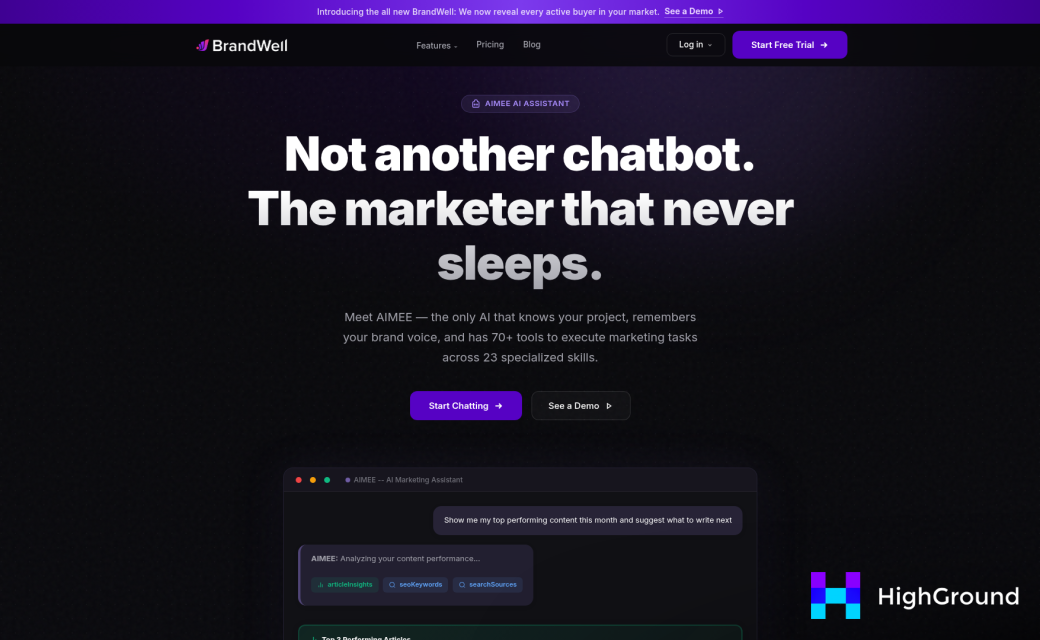
BrandWell is not a general-purpose writing assistant where you build and smooth out content step by step - it’s a production-focused tool and the design reflects that. The platform makes decisions for you so you can publish faster.
That distinction matters because it shapes everything about how BrandWell fits into a workflow. Some find that freeing - they want a draft ready to edit in minutes, not a tool that asks them to make a dozen decisions first. Others want more control over structure, tone and sourcing before anything gets written.
The helpful question to hold onto here is whether speed or control matters more to how you work. There’s no wrong answer, but your answer will change how helpful BrandWell is to you in practice. A content team trying to scale output across dozens of posts per month will have a very different experience than a solo writer who edits every line.
BrandWell leans hard into the speed side of that equation. The platform is built for users who want to remove the slow parts of content production - research, outlining, drafting - and focus their time on reviewing and publishing. It’s the model it runs on and it’s the lens you’ll want to use when looking at its features.
How BrandWell Generates a Blog Post From Start to Finish
The process is straightforward - and that’s the whole point. You put in a keyword or topic and BrandWell takes it from there without asking you for much else.
Here is how it goes from input to finished post.
- Enter a keyword or topic. This is all the input BrandWell needs to get started. You don’t write a brief or fill out a long form.
- BrandWell researches and structures the content. It figures out how to organize the article, what subtopics to include, and how to frame the piece around that keyword.
- The article gets written automatically. A finished draft of 2,500 or more words is ready in a matter of minutes.
- On-page SEO elements are added. This includes a title tag, meta description, table of contents, and internal links - all generated without extra steps from you.
- You review and publish. The draft lands in your BrandWell dashboard and you can edit, export, or send it straight to your CMS.
The appeal here is speed. A long-form post that might take a writer a few hours to research and draft is ready in under five minutes. For teams that need to publish at volume, that turnaround changes how they plan their content calendars.

The low input is also worth thinking about. Because BrandWell only needs a keyword to start, it doesn’t know your brand voice, your audience, or the angle you want to take. The output is shaped by what ranks well for that topic - not by what makes your brand different from everyone else writing about the same thing.
That doesn’t make the tool less helpful - it just means the drafts usually need a human pass before they go live. What BrandWell produces is a well-structured starting point instead of a finished product you’d publish word for word. The bones are good: the structure is logical, the SEO elements are in place, and the length is there. What it won’t have by default is your perspective or your tone.
For most users, that trade-off makes sense. The time saved on research and structure alone is enough to justify the workflow - even if editing is still part of the process.
BrandWell’s Plans, Pricing, and What You Actually Get
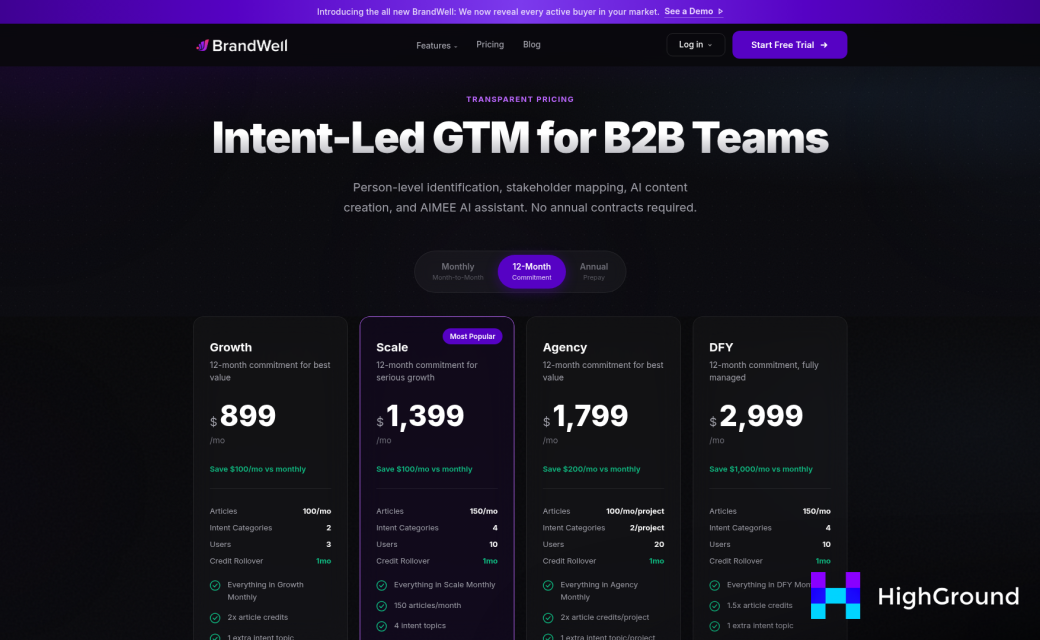
BrandWell has two paid plans and the difference between them can depend on how many users and sites you’ll have to manage. Here is a side-by-side look at what each plan includes.
| Feature | Essentials ($249/month) | Agency ($499/month) |
|---|---|---|
| Users | 1 | 2 |
| Connected Sites | 2 | 4 |
| Posts Per Month | 25 | Varies |
The Essentials plan gives you 25 posts per month across as many as 2 sites, which works out to roughly $10 per post at full capacity. That math only makes sense if you are hitting that 25-post limit each month. If you are publishing less than that, the per-post cost goes up fast.
The Agency plan doubles the site count and adds a second user seat, which makes it more helpful for small teams or freelancers who manage client blogs. The price jump to $499 is notable, so it’s worth weighing the extra seats and sites against what you’ll actually use.
It is also worth learning about what is not included by default. BrandWell does not generate images, and the posts it creates still need a human pass to check facts, fix tone, and customize the content to your audience. You are paying for a strong structural draft, not a finished product.
BrandWell does have a free AI detector tool that anyone can access without an account. It checks text for signs of AI-generated content, but there’s a 2,500-character cap per check. That is enough to scan a few paragraphs, not a full post, so it’s more helpful as a quick spot check than a full document audit.
The free tool is a low-stakes way to test part of BrandWell’s technology before committing to a paid plan. It will not tell you everything about how the full platform performs, but it gives you a chance to poke around.
The pricing makes more sense for a tool built for volume. If you need to publish SEO-focused content on a steady schedule, the per-post cost is much easier to justify. If you only need a handful of posts each month, a lower-volume tool could be a better fit for your budget.
Where BrandWell Performs Well (With Some Caveats)
BrandWell has some genuine strengths worth noting before getting to the limitations. Speed and scale are the two most obvious ones. You can go from a keyword to a full long-form post in minutes. If you need to produce content at volume, that turnaround time is hard to match manually.
The platform supports over 35,000 intent-based topics, which means it has a large foundation to pull from when generating content. That range makes it more flexible than tools built around narrower content categories.

BrandWell’s own content team has also shared some concrete numbers. They reported growing their indexed keywords from 165 to over 15,000 in four months, with hundreds of those keywords landing in top-three positions on search results. Those are actual figures from a real use case, and they’re worth taking seriously as a signal of what the tool can do.
The fair caveat is that those results came from BrandWell’s own team using their own tool in conditions they controlled. Your niche, your domain authority, and how much you edit the output will all affect what you see.
A quick summary of where the platform tends to be at its best:
- Fast content output - full articles in minutes rather than hours
- High-volume production without a proportional increase in time or cost
- Wide topic coverage across 35,000+ intent categories
- Built-in SEO structure so you’re not starting from a blank page
- A research-to-draft workflow that keeps things moving without too many tool switches
The SEO structure point is worth expanding a little. BrandWell generates content built around headings, keyword placement, and content length in a way that aligns well with how search engines like to review pages. That saves time in the editing stage. If you want more control over how your content is shaped from the start, adjusting your post writing preferences can make a meaningful difference in output quality.
What you get is a strong starting point, not a finished product. The output quality is high enough that editing requires refinement instead of a rebuild, which is where many AI writing tools fall short. Tools that let you edit pipeline prompts give you even more leverage over what comes out the other end.
Results in the range BrandWell’s team reported are possible, but they’re not guaranteed. A newer site or a very competitive niche will respond differently than an established domain with existing authority. Keep that in mind as you consider whether the platform fits your situation.
The Limitations You’ll Run Into Using BrandWell
Now for the honest part. BrandWell does things well, but there are actual friction points that will frustrate some users more than others.
The biggest one is they don’t have a lot of pipeline control. You can’t meaningfully customize how BrandWell builds a post from the inside out. The structure, the angle, the way it frames a topic - most of that’s decided. For a solo blogger who just wants something publishable fast, that’s fine. For a content team with a defined brand voice or an editorial process, it gets restrictive faster.
Agencies tend to feel this the most. When making content for multiple clients with different voices and audiences, a rigid generation pipeline can become a real bottleneck. More time gets spent editing to fit the client than was saved with the tool.
The AI detector built into BrandWell also deserves a look - it performs well on simple, unedited AI text - around 90% accuracy. But once content gets refined or humanized, that accuracy drops to the 70-75% range; it’s a real gap if you’re relying on the detector to flag content before it goes out.
Here’s a quick rundown of the drawbacks worth learning about.
- You can’t adjust the article structure or generation logic to match your workflow.
- Brand voice customization is limited compared to tools built specifically for that purpose.
- The AI detector loses reliability on polished or lightly edited content.
- Output quality varies across niche topics where training data is thinner.
- There’s no granular control over internal linking or content hierarchy during generation.
None of these are dealbreakers for every user. But they do point to something worth thinking about before you commit. If your content process is flexible and your job is volume, then you’ll adapt to BrandWell’s constraints pretty easily. If you need the tool to adapt to you, that’s where the friction starts.
Solo bloggers in large niches will probably get the most mileage with the least frustration. Content teams and agencies with strict brand guidelines will find themselves hitting walls that no amount of prompt tweaking can completely fix. If you want to dig deeper into how different tools handle these challenges, our blog covers a range of comparisons and workflows worth browsing.
So, Is BrandWell the Right Fit for You?
No tool works for everyone, and BrandWell is no exception. The most honest way to review it is to run it against an actual piece of content from your own workflow - not a test prompt - and see how much work the output saves you versus creates.

If the tradeoff fits, it can be a helpful addition. If it doesn’t, that’s helpful to know too. In either case, the trial will tell you more than any review will.
FAQs
What is BrandWell and what does it do?
BrandWell is an AI content platform that generates long-form blog posts from a single keyword or topic. It handles research, structuring, writing, and basic SEO elements automatically, producing drafts of 2,500+ words in minutes.
How much does BrandWell cost per month?
BrandWell offers two plans: Essentials at $249/month (1 user, 2 sites, 25 posts) and Agency at $499/month (2 users, 4 sites). The per-post cost only makes financial sense if you consistently hit your monthly post limit.
Does BrandWell produce publish-ready content?
No. BrandWell produces well-structured drafts, but they typically require a human editing pass to add brand voice, verify facts, and tailor content to your audience. It’s a strong starting point, not a finished product.
What are BrandWell’s biggest limitations?
BrandWell offers limited pipeline control, meaning you can’t easily customize article structure or tone during generation. Brand voice customization is also restricted, and its AI detector loses accuracy on polished or lightly edited content.
Who is BrandWell best suited for?
BrandWell works best for solo bloggers and content teams needing high-volume SEO content quickly. It’s less ideal for agencies or teams with strict brand guidelines, as its rigid generation process can create editing bottlenecks.